Before an AI Agent Acts in the Yard
Before an AI agent answers a pickup inquiry or acts in a yard, verify the asset, the freshness and source of the evidence, and who has authority to act.
Chris MachutRead the article
A driver asks whether trailer 5317 is ready for pickup. The system says it arrived. An AI agent could retrieve that record, draft an answer and prepare the next step in seconds. Before anyone sends a driver across the yard, a few ordinary questions need answers. Was it actually trailer 5317? Where was it seen? When? Can the person responsible inspect the evidence?
The trailer, meanwhile, has declined to join the meeting and clear this up for us. That leaves the people, the records and whatever evidence the systems captured.
McKinsey’s January 2026 article, The automation curve in agentic commerce, offers a useful way to think about delegation. It describes different degrees of assistance and execution in shopping, and argues that the appropriate level depends on the situation and what people are willing to delegate. I think logistics leaders should ask the same question, starting with the evidence underneath the decision.
The record has to refer to the right asset
In the trailer example, an arrival record is one piece of the answer. It does not establish that the trailer is loaded, cleared for release or available to the driver asking about it. Those are separate operating questions. A system can retrieve the right arrival event and still draw the wrong conclusion about what should happen next.
Even the identification deserves scrutiny. A camera observation, an operator’s entry and an imported system record can disagree. Connecting an identifier to the correct unit, event and supporting image lets someone review the result. If the evidence is uncertain, that uncertainty needs to travel with the record.
I would start an agent project with one operating decision and trace the information it actually needs. For a pickup inquiry, that might include the observed identifier, location, observation time, release status and the source of each fact. A polished demonstration gets awkward quickly when the first operator asks, “Which trailer?”
A current answer needs a history
A record can have been correct when it was created and still be a poor basis for today’s decision. Yesterday’s observation tells us something useful about yesterday. It does not establish where the trailer is now. The time an event was observed also needs to remain distinct from the time another system received or processed it.
There is useful work to build on. GS1’s EPCIS standard defines interfaces and a model for sharing event information about assets, including status, location, movement and chain of custody. A common format helps systems exchange information. It cannot make an incorrect observation accurate.
My practical test is whether the next person can inspect how the answer was reached. Show the observation and its time. Identify the source. Preserve corrections and conflicting evidence. When a shift changes, the next owner should inherit enough context to resolve the exception without reconstructing the whole conversation.
Permission is a separate decision
McKinsey’s discussion of business purchasing makes a useful distinction: authority in an organization comes through policies, budgets and other institutional constraints. Having enough information to recommend an action does not, by itself, grant permission to execute it.
The same distinction applies in a yard. Looking up an arrival, preparing an exception for review and authorizing a release have different consequences. I would evaluate each separately. A bounded retry of a failed system message might be appropriate in one workflow. A disputed asset release may require a person with specific authority, even when the agent has assembled excellent evidence.
Design the failure path before celebrating the happy path. Decide what happens when records disagree, evidence is stale or a receiving system never confirms acceptance. Name the person who takes the exception and make the permitted action clear. Some physical actions are much harder to undo than a draft message.
Start with one use case, not the whole yard
That is the approach behind our Supply Chain AI Starter Guide. It helps teams choose one operational decision, test a bounded change and decide whether the result has earned a place in the daily workflow.
I appreciate the irony of handing busy people a substantial PDF about getting started. Please do not turn reading it into your first AI project. Open the two-page Use-Case Record and pick one question your team already answers repeatedly.
For the trailer example, the first use case could be preparing a pickup-status answer for an operator to review. Keep release authorization with the person who already owns it. Before building anything, put five things on the record:
The decision: what question are we helping someone answer?
The owner: who reviews the answer and authorizes any action?
The evidence: which records are needed, how current must they be, and what happens when they disagree?
The baseline: how long does a correct answer take today, and how often does it need correction?
The stop condition: when should the system hand the question back to a person?
Then test a small set of ordinary cases and a few uncomfortable ones: an uncertain identifier, an old observation or a missing confirmation. Compare the answers with the current process. A simpler process fix may be the right outcome.
The first useful result might be an operator getting a reliable answer faster, with the source visible and the next action clear. That is enough to learn from. Start there, before giving software the keys to the rest of the yard.
Related work
Find this in the history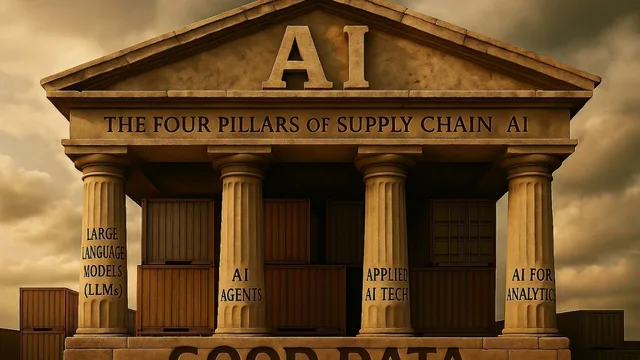
From Buzz to Blueprint: Two Years on the Road with the Four Pillars of AI
A field report from a dozen stages, four webinars, and a couple hundred honest poll responses on how the supply chain actually adopts AI.
The First AI Shift Has Already Happened
Six months ago, a lot of companies were still treating AI as something to restrict, contain, or keep away from anything that looked remotely sensitive.

Spire: The Five Keys To Business Bliss
In this podcast and article on ThoughtLeadership.biz, Mr. Machut talks about nurturing our creative energies and engaging in meaningful learning activities to increase wellbeing.