
Where artificial intelligence creates return-on-investment, where it quietly adds cost, and why experienced humans still need decision authority
For the past six months, I have been saying that the AI pendulum would eventually swing back toward people. I did not believe that because AI was slowing down or because the technology had somehow failed. I believed it because companies were beginning to use a tool designed to amplify capability as a blunt instrument for making organizations smaller. Eventually, the contradiction between those two goals was going to show up in the business results.
Then I read Ben Shimkus’s reporting in Business Insider about Ford’s effort to improve vehicle quality.
Ford has spent years working through quality problems while investing in AI and automated inspection. However, an important part of its quality turnaround did not come from removing more people from the process. Ford hired, promoted, or brought back approximately 350 experienced technical specialists who now mentor younger engineers, lead design reviews, identify potential failure points, and help improve the company’s AI and automated quality tools. [1]
My reaction was not that Ford had proved AI failed. Ford proved that AI without experienced humans, trusted information, validation, and real decision authority is a very confident intern with a clipboard. The intern may be fast, consistent, and impressive during a demonstration, but it still does not know what it does not know.
What stayed with me was the knowledge Ford was trying to preserve and recover. The expertise held by veteran engineers does not sit neatly in a database waiting for a model to ingest it. It lives in years of pattern recognition, mistakes remembered, conversations between departments, unusual failures, and subtle warning signs that only make sense after someone has seen enough of the real world.
Ford’s vice president of vehicle hardware engineering, Charles Poon, acknowledged that the company had not done enough to preserve the knowledge of some of its most experienced engineers. He also explained that quality problems often appeared at the boundaries between teams, where manufacturing, design, software, and hardware intersect. [1]
That is exactly where human expertise becomes difficult to replace. The most valuable knowledge inside a company often lives between the documented steps, inside the exceptions, handoffs, and judgment calls that never made it into the official process.
When experienced people leave, a company does not simply lose labor capacity. It loses context, judgment, and institutional memory. When an AI system later fails to reproduce knowledge that was never documented, structured, or transferred, we blame the technology for a human decision that may have been made years earlier.
The technology is not making these choices
We have started talking about AI as though it walked into the boardroom and developed its own workforce strategy. It did not choose the cost-reduction target, decide which experienced people had become expendable, or conclude that a customer should be trapped inside an automated service process with no way to reach someone who can help.
AI did not decide that a job applicant could be rejected without understanding why. It did not decide that an employee should be measured by an algorithm they cannot question. It did not decide that a professional could approve work they had not meaningfully reviewed.
People made those choices. The technology created distance between the people making the decision and the people forced to live with the consequences. It made the decision easier to scale, easier to present as data-driven, and sometimes easier for leadership to avoid personally owning.
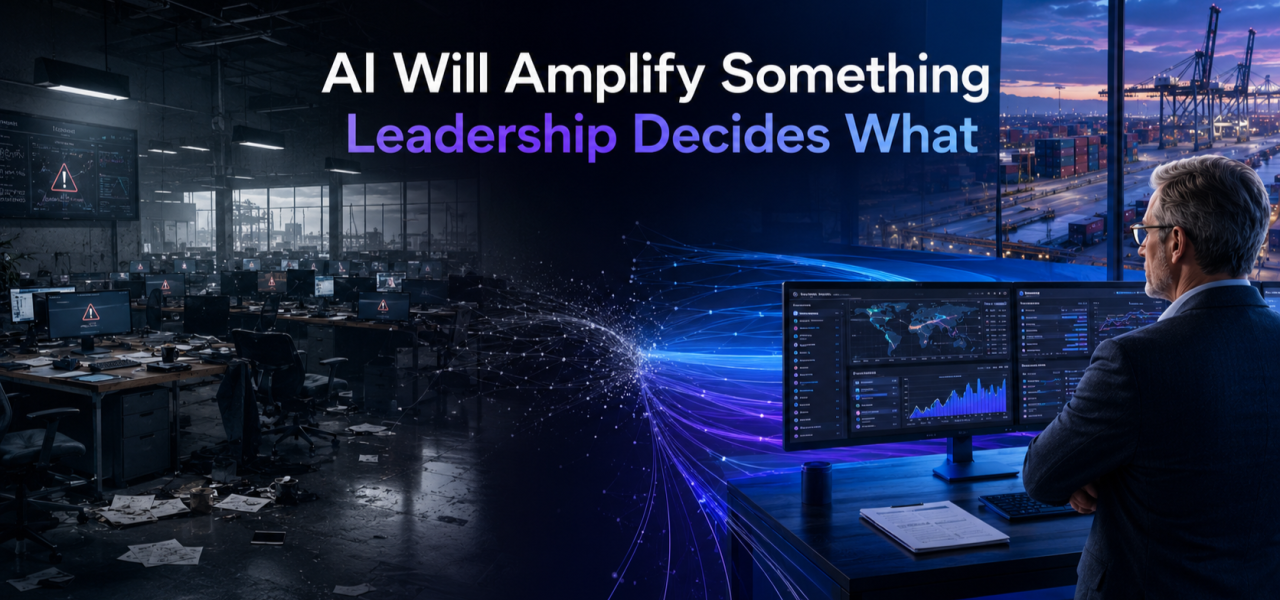
That distinction matters because AI is an amplifier. It is not a shrink ray.
AI can amplify expertise, service, quality, visibility, speed, and human potential. It can also amplify a biased process, an incomplete record, a bad assumption, or a leadership decision that nobody wants to defend without an algorithm standing between them and the outcome.
The technology will pursue the objective it is given. The human impact depends on the objective people chose.
You are probably under real pressure to show results
If you are leading an AI initiative right now, you are likely carrying a complicated mandate. Your board wants progress, your executive team wants measurable ROI, and your employees want to know what the technology means for their future. Your customers expect a better experience, but they do not want to become unwilling participants in your experiment.
At the same time, you are being told that everyone else is moving faster. The market is full of AI success stories, impressive demonstrations, urgent predictions, and confident claims about what will soon be automated. In that environment, reducing headcount becomes an attractive target because it is one of the easiest results to place into a spreadsheet.
A person costs a known amount. A software subscription costs a known amount. The subtraction appears clean.
Human capability is more difficult to measure. How do you quantify the value of the engineer who recognizes a familiar failure pattern before anyone else does? How do you measure the supervisor who knows when a report cannot be trusted, or the customer service representative who understands that the written policy does not fit the human situation in front of them?
Those capabilities often become visible only after they are gone. The expected savings then return as rework, quality failures, customer frustration, slower decisions, outside consultants, rehiring, retraining, and a growing number of exceptions that nobody clearly owns.
The financial cost is real. The loss of credibility and trust can be much more expensive.
The consequences are already reaching real people
The Ford story is not an isolated warning. During 2026, we have already seen examples in hiring, healthcare, and the legal system where the absence of meaningful human judgment created serious consequences.
Researchers from Stanford studied 3.4 million people who submitted approximately four million applications to 1,700 job postings across 150 employers. Each application was evaluated by an AI hiring tool from a single third-party vendor. [2]
The researchers found that 26 percent of Black applicants and 15 percent of Asian applicants applied for positions where the system produced adverse impact against their racial group. They estimated that approximately 40,000 more applications from Black and Asian candidates would have advanced if those candidates had been recommended at the same rate as the most-favored group. [2]
Those are not simply model-performance statistics. They represent real people who may never know why an opportunity disappeared or whether anyone capable of understanding their experience ever saw their application.
The study also identified another risk that deserves more attention. When many employers rely on the same algorithmic vendor, the same people can be repeatedly rejected across multiple organizations. The researchers described this as an algorithmic monoculture: one system’s assumptions can follow a person from application to application, even when the employers appear to be making independent decisions. [2]
The legal profession provides another example of responsibility becoming blurred by AI. In May 2026, Reuters legal reporter Mike Scarcella reported that a federal judge sanctioned the manager of a California law firm after a junior attorney submitted an AI-assisted court brief containing a false case citation. [3]
The judge’s message was straightforward. Supervising professionals remain responsible for the work produced under their authority. A leader cannot delegate work to a junior employee, allow that employee to rely on AI, and then claim that responsibility disappeared somewhere inside the technology.
The AI did not decide that verification was optional. A person made that choice, or a leader created a process in which meaningful review was unlikely to happen.
Healthcare raises the stakes even further. In a February 2026 Reuters investigation, Jaimi Dowdell, Steve Stecklow, Chad Terhune, and Rachael Levy examined safety reports, legal records, regulatory documents, and interviews involving AI-enhanced medical devices. [4]
The investigation reported that after AI was added to one surgical navigation system, the U.S. Food and Drug Administration received unconfirmed reports of at least 100 malfunctions and adverse events. At least 10 reported injuries occurred between late 2021 and November 2025. [4]
Those reports do not establish that AI caused the injuries. Reuters explicitly noted that FDA reports may be incomplete and are not intended to determine causation. The manufacturer also said there was no credible evidence linking the system’s AI technology to the alleged injuries. [4]
That uncertainty does not make the story less important. It makes the need for clear responsibility even more important. Validation standards, implementation timelines, escalation procedures, staffing levels, and the authority to challenge a system are all human decisions made before a patient carries the risk.
This is the human impact that gets lost when we discuss AI as though the technology acts independently. An algorithm cannot accept responsibility, restore someone’s career, repair a professional reputation, or explain to a patient’s family why the safeguards were insufficient. The humans who design, approve, deploy, and oversee the system remain accountable, even when the process makes that accountability difficult to see.
Where AI adds cost
I see three common patterns in AI programs that initially look efficient but eventually add financial, operational, and human cost. They are replacement, reduction, and the removal of authority.
Replacement begins with the false assumption that a person and their visible tasks are the same thing. They are not. A role usually contains relationships, judgment, informal knowledge, exception handling, and responsibilities that never appear in a process map.
A company may automate sixty percent of someone’s visible tasks and conclude that it can remove one hundred percent of the person. The invisible forty percent does not disappear. It moves into another department, becomes an escalation, reaches the customer, or emerges as a problem that nobody realizes the former employee had been quietly preventing.
The cost appears as mistakes, delays, missed handoffs, rework, and work that no longer has a clear owner. It can also appear as a credibility problem when leadership later has to hire back the expertise it previously declared unnecessary.
Reduction is a related mistake, but it begins with the target rather than the role. For decades, businesses have treated headcount reduction as one of the cleanest and most understandable measures of efficiency. AI arrives, and the first instinct is to point this entirely new capability toward the same old objective.
That approach wastes much of what makes AI valuable. AI can increase throughput, expand service capacity, reveal revenue leakage, identify risk, improve quality, and make expertise available across an organization. Using all of that capability only to reduce payroll is like buying a fleet of trucks because you wanted fewer parking spaces. You have acquired a powerful tool while measuring the wrong outcome.
The third pattern is the removal of authority. This is often the most dangerous because the organization can still claim that a human remains in the loop.
The employee may be able to see the recommendation but lack the ability to change it. They may recognize that the information is wrong but be unable to correct the workflow. They may be expected to review hundreds of outputs each day while receiving only seconds to approve each one.
Over time, the person learns that questioning the system creates more work, slows their performance metrics, or requires approval from someone several levels above them. Eventually, they click approve because the process has trained them to do so.
The company can still say the output was human-reviewed. In reality, the person was not exercising judgment. They were watching the loop, and in some cases they were being positioned to absorb responsibility for it.
Human presence is not the same as human oversight. Real oversight requires expertise, context, time, evidence, accountability, and the authority to stop or change the decision.
Where AI creates ROI
The strongest AI investments follow a different pattern. Instead of starting with replacement, reduction, or removal, they begin with reinforcing, restructuring, and revealing.
Reinforcing means giving capable people better leverage. An engineer can identify failure patterns earlier. A recruiter can spend less time organizing applications and more time understanding candidates. A customer service representative can receive the complete history of a problem, see the likely resolution, and have the authority to solve it during the first conversation.
In physical operations, reinforcement means the operations manager no longer has to assemble yesterday’s truth from radios, spreadsheets, camera feeds, handwritten notes, and several disconnected systems. Trusted information reaches the manager quickly enough to make a decision while the decision still matters.
The person does not become less important. Their judgment becomes more scalable.
Restructuring goes deeper than inserting an AI assistant into an existing workflow. It requires the company to reconsider which work machines should handle, which decisions people should own, and where the handoff between them must occur.
AI can search, classify, monitor, summarize, compare, detect, and recommend at a scale people cannot match. Humans are better suited for context, ambiguity, relationships, accountability, unusual exceptions, and decisions that affect the lives of other people.
The goal should not be to automate every possible step. The goal should be to create a workflow that is fast where speed matters, careful where consequences matter, and explicit about where human authority lives.
Revealing may become one of the most valuable AI applications of all. AI can expose conditions, patterns, and risks that a business has never been able to see consistently.
This is especially important in physical operations. A trailer enters a yard, a container changes chassis, a truck arrives out of sequence, or an asset moves between shifts. The physical event has happened, but the digital system may learn about it late, record it incorrectly, or never receive the information at all.
AI does not operate directly on physical reality. It operates on the business’s digital version of that reality. When the digital version is incomplete, fragmented, late, or wrong, AI does not become smarter. It becomes faster at being wrong.
This is an issue I have seen firsthand through our work at SiteTrax.io. A camera detecting an asset identifier is not automatically the same as creating trusted operational data. The business needs to know what happened, which asset was involved, where and when it occurred, what context surrounded the event, and whether the information is reliable enough for a person or another system to act on it.
We translate physical activity into clean, structured, real-time data so that people and AI systems can act on what actually happened. The purpose is not to remove people from the operation. It is to stop forcing good people to operate blind.
Human in the loop is not enough
Nearly every organization deploying AI now says it has a human in the loop. The phrase sounds responsible, but by itself it tells us almost nothing.
We need to know who the human is, whether they understand the work well enough to recognize when the system is wrong, and whether they can see the evidence behind its recommendation. We also need to know whether they have enough time to review the output meaningfully.
Most importantly, we need to know whether they can stop the workflow, correct the information, reverse the decision, or escalate the issue without being punished for slowing the system down.
When the answer is no, the human is not meaningfully in the loop. They are simply near it.
The distinction is authority. Experienced people must help shape the data, define the rules, test the system, validate the outputs, and own the escalation points. The people who understand the exceptions are not obstacles to automation. They are the reason automation survives contact with the real world.
The future is not AI replacing expertise. The more valuable future is expertise becoming scalable.
What we need to change together
I do not believe the answer is to slow down AI. I believe the answer is to become much more intentional about what we ask it to amplify.
Before approving an AI initiative, leadership should be able to explain which human capability the system strengthens and what new value it creates beyond labor reduction. Leaders should understand what information the AI operates on, how closely that information reflects reality, and who has the authority to challenge the output.
They should also be able to answer a more uncomfortable question: when the system is wrong, who carries the consequence?
Is it the executive who approved the deployment, the manager who designed the workflow, or the employee expected to supervise hundreds of automated decisions? Is it the customer who cannot reach a person, the applicant who never learns why they were rejected, or the patient who assumed the system had been tested more thoroughly than it was?
Accountability cannot become less clear as automation becomes more powerful. It has to become more clear.
The decision in front of us now
We are still early enough to decide what kind of AI economy and what kind of workplace we are building. We can use AI to reduce people, remove their authority, and distance decision-makers from the consequences. That approach may create a fast cost reduction, followed by a much longer bill in capability, quality, credibility, and trust.
We can also use AI to reinforce people, restructure work, reveal what was previously invisible, and make hard-earned expertise available at scale. That is not the softer or less ambitious path. It is the path more likely to produce durable ROI.
AI will amplify something. Leadership must decide whether it amplifies human expertise, opportunity, and potential, or whether it amplifies our oldest assumptions about people being costs to remove.
The most important question is not simply whether a human remains in the loop. It is whether that human knows enough, sees enough, and has enough authority to say that the system is wrong… and whether the rest of the organization is still human enough to listen.
References
[1] Shimkus, Ben. “Ford Says AI Alone Couldn’t Fix Its Quality Problems. It Needed to Rehire Veteran Engineers to Help.” Business Insider, June 25, 2026. [2] Bommasani, Rishi, Sarah H. Bana, Kathleen A. Creel, Dan Jurafsky, and Percy Liang. “AI Hiring Tools Can Yield Racial Bias and Systemic Rejection.” Stanford Institute for Human-Centered Artificial Intelligence, May 26, 2026. [3] Scarcella, Mike. “US Judge Says Senior Lawyers Must Pay for Mistakes by Subordinates Using AI Tools.” Reuters, May 1, 2026. [4] Dowdell, Jaimi, Steve Stecklow, Chad Terhune, and Rachael Levy. “As AI Enters the Operating Room, Reports Arise of Botched Surgeries and Misidentified Body Parts.” Reuters, February 9, 2026; updated March 2, 2026.Originally published on LinkedIn, July 14, 2026.


Latest posts by Chris Machut (see all)
- AI Is an Amplifier, Not a Shrink Ray - July 14, 2026
- From Buzz to Blueprint: Two Years on the Road with the Four Pillars of AI - June 17, 2026
- The First AI Shift Has Already Happened - May 12, 2026