
By the middle of a long morning of student pitches, you usually know what kind of day you are in for.
You can feel pretty quickly whether the room is running on rehearsal or wishful thinking. A few teams will have an idea with some life in it. A few will have something that sounds promising until the second question lands. A few will be working hard and still not quite know what they are trying to say. If you have spent enough time in pitch rooms, startup meetings, advisory boards, or any other place where people are forced to explain an idea out loud, you develop a feel for the difference between something that has been lived with and something that has merely been assembled the night before.
That is part of why the morning of May 1 has stuck with me.
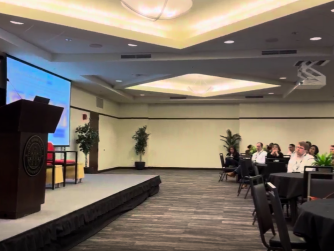
I spent that morning at Kempsville High School’s Entrepreneurship and Business Academy, from 7:30 until 12:30, listening to 16 student teams present business ideas, prototypes, and pitches in front of judges and mentors. It was five straight hours of concentrated attention, the kind that leaves you mentally drained by lunch and a little less charitable in the best possible way. By then you are not applauding effort on instinct. You are listening for what actually holds up.
And somewhere in the middle of that long stretch, it became difficult to ignore that something had changed.
I do not mean the students had better slides, although many of them did. I do not mean they had picked up some business vocabulary and learned how to say market fit with a straight face. I mean the quality of the thinking felt different. The ideas were stronger. The execution was stronger. The presentations were stronger. More than that, the students seemed more ready than I am used to seeing at that stage, which is not a compliment I hand out lightly after years of watching young people try to bring half-formed ideas into a room full of adults.
What caught my attention most was not the technology itself. It was the confidence.
Not the borrowed kind, and not the brittle kind that disappears the moment someone presses on the weak part of the plan. What I mean is the kind of confidence that shows up when a student has spent enough time working through an idea that it starts to sound like their own. They can explain what they are building in plain language. They can tell you why they chose one direction over another. They can hear a challenge without treating it like a personal attack. They can stay in the conversation.
That is a different thing, and it is much harder to fake than adults sometimes imagine.
This was not a school exercise dressed up as one
For anyone outside Virginia Beach, a little context matters because EBA is not just a class project with a nice acronym and a banner on the wall.
Kempsville’s Entrepreneurship and Business Academy is a structured program inside the high school, built around business-focused pathways that include entrepreneurship and innovation, business information technology, and corporate finance, along with dual-enrollment opportunities, internships, and a culminating presentation in front of business and community leaders. That matters because the students know the room is real. They are not speaking into a vacuum, and they are not being graded only by people who already know what they meant to say. They have to stand up, make a case, and deal with scrutiny.
Julia Dieter has helped lead that program, and it shows in the structure around the students and in the way they carry themselves. Mike Zeiders and Marty Kaszubowski were there, and so were several other founders, operators, and business leaders from across Hampton Roads who took a good part of their morning to listen, question, and encourage. I want to be careful with that because I do not want the article to narrow the credit to two names when the broader point is that a serious local business community showed up for students in a serious way. Young people can tell the difference between ceremonial attention and the real thing, and this was the real thing.
That matters more than most people think. A judged room changes behavior. It changes preparation. It sharpens the students, and it sharpens the adults too, because everyone understands that encouragement is useful, but vague encouragement is cheap. What students actually need is a room that will listen carefully enough to take them seriously.
The surprise was not that students used AI
The least interesting version of this story is that high school students used AI. Of course they did. That fact alone tells us almost nothing now, and it certainly is not enough to carry an editorial.
What mattered was what happened because they were allowed to use it with some structure.
Before this event, I taught the students a simple prompting framework I use called C.A.R.E., which stands for Context, Action, Results, and Example. There is nothing magical about it, and that is part of why it works. Most disappointing AI output is really just vague human thinking reflected back through a machine. People ask for something fuzzy, get something fuzzy, and then blame the tool for telling on them. C.A.R.E. gives students a practical way to slow down for a minute, define what role they want the tool to play, state the task clearly, describe the result they need, and provide an example when one would help.
What I saw in that room suggested that structure mattered.
More than once, students openly referenced using AI as part of the process, and judges responded not just to the finished image or concept on the screen, but to the fact that the students had been able to turn something fuzzy in their heads into something visible enough to react to. In the debrief afterward, that was one of the things that stood out most. The students were not hiding the tool. They were using it to get to clarity faster, which meant they had more time left for the work that still belonged entirely to them.
That last part is where the real story lives.
If you have ever tried to start a business, build a product, write a proposal, design a service, or even explain a new idea to another person without sounding ridiculous, then you know how much energy gets lost in the earliest stage of the process. The beginning is usually the ugliest part. You have an instinct but not a form. You have a direction but not a sentence for it yet. You can feel the shape of the thing without being able to show it to anyone else. That stage kills momentum for talented people all the time, not because they are short on ideas but because they get stuck in the swamp before the real work can even begin.
These students seemed to be moving through that stage faster. They could see options sooner, reject weak ones sooner, refine sooner, and then spend more of their energy on judgment, rehearsal, customer thinking, and delivery. By the time they got in front of us, many of them had already put in more reps than students usually get that early in the cycle.
AI did not stand in front of the room and answer questions
This is the distinction that matters most, and it is the one too many educators still glide past.
The students had to do the hard human part themselves. They had to decide what made sense. They had to figure out whether the story held together. They had to answer the questions, absorb the criticism, defend the weak spots, and keep speaking once the conversation got uncomfortable. That is why the confidence caught my attention. It was not the confidence of someone hiding behind a machine. It was the confidence of someone who had been able to get through enough iterations before the live moment that they no longer sounded like they were inventing the whole thing as they went.
That is also why I keep coming back to the difference between output and readiness. Plenty of people can dismiss AI-generated imagery, draft taglines, or first-pass concepts as shortcuts, and sometimes they are. It is much harder to dismiss a student who can stand there in front of adults, explain what they built, defend the reasoning behind it, and respond without collapsing the second the discussion stops being friendly. That is not a software story anymore. That is a preparation story.
And that, to me, is where the higher education piece becomes uncomfortable.
Too much of higher education is still grading the wrong thing
Last November I wrote that schools are making a mistake when they treat AI as something to fear, quarantine, or ban instead of something students need to learn how to use responsibly. My argument was not that AI would magically improve learning on its own. It was that AI is becoming part of baseline workplace literacy, and students who are never taught how to work with it critically will not leave school more principled. They will leave less prepared.
What I saw at Kempsville felt like the follow-through on that argument.
Too much of education still gives moral status to friction simply because it is familiar. If something took longer, we assume it must have been more rigorous. If it required more manual effort, we assume it must have produced deeper learning. Sometimes that is true. Plenty of foundational work still deserves the long way around. But sometimes the extra friction is just inherited process, and calling it rigor only hides the fact that students are being trained on constraints the workplace has already started to abandon.
That is the part colleges should be thinking hard about. The real question is not whether students will have access to these tools. They already do, and pretending otherwise is more nostalgic than serious. The question is whether students are going to be taught how to use them well, how to verify what comes back, how to challenge weak output, and how to stand behind the decisions they make once the machine has done its part.
That is education too. In fact, at this point it is becoming a very important part of education.
What stayed with me after the room cleared
When the event ended, I did not walk out thinking about software. I did not walk out thinking about model names or prompting tricks or whether a policy committee somewhere has finally agreed on acceptable classroom use.
I walked out thinking about students and about how many capable people get trapped behind unnecessary friction.
I thought about what it means for a teenager to get to clarity earlier than students used to. I thought about how much confidence can change once a person sees that they can take an idea, shape it, test it, present it, and survive critique without getting flattened by it. I thought about how many adults still talk as though confidence is some soft, ornamental quality when in practice it changes behavior, ambition, and willingness to enter the arena.
That is why I do not think this is a small story. What I saw at Kempsville was not proof that AI solves education, because it does not and never will. Good programs still need structure, standards, thoughtful teachers, real feedback, and adults willing to give their time. EBA had all of that, and the students responded to it. But I also do not think it is an accident that those students looked more prepared in a year when they had practical ways to work with AI instead of being told to pretend it did not exist.
If colleges really want to prepare students for the world they are entering, then they should want them to move beyond old unaided limits without surrendering judgment. They should want students to get to clarity faster and become better at defending what they build once they get there. What I saw in that high school pitch room was not a shortcut around learning. It was a glimpse of what learning can look like when students are allowed to work with leverage before the workforce forces the lesson on them.
Some colleges are still arguing about whether that shift should happen, while some high school students are already living inside it.
Thank you
I’m grateful to Julia Dieter and Meghan Timlin with Kempsville High School, who have taken over the EBA program from Ashley Houchins Smith along with my fellow volunteers such as Mike Zeiders, Marty Kaszubowski and the many other business leaders, mentors and volunteers from across Hampton Roads, and the broader community that keeps showing up for these students year after year. Programs like #EBAProud do not move forward on good intentions alone. They move forward because people give their time, share their judgment, and keep deciding that the next generation is worth investing in.
And if there is one last thought I am left with, it is that one of the best uses of AI is not replacing thought, but helping us bring thought into focus. I saw that in the students this morning, and I felt it again when I sat down to put this into words.


Latest posts by Chris Machut (see all)
- AI Is an Amplifier, Not a Shrink Ray - July 14, 2026
- From Buzz to Blueprint: Two Years on the Road with the Four Pillars of AI - June 17, 2026
- The First AI Shift Has Already Happened - May 12, 2026