

I was a junior at Virginia Tech when The Matrix was released in 1999. Like many people my age, I walked into the theater expecting an action movie and walked out with far more questions than answers. A group of friends and I went back to our college apartment afterward, opened a few beers and spent hours talking through what we had just seen. Not the effects or fight scenes, but the ideas—reality, control, autonomy, and what happens when systems begin to operate beyond human perception.
At the time, it felt like pure science fiction—intellectually stimulating, unsettling and distant from anything we would encounter in our professional lives. But looking back now, the movie didn’t age the way most science fiction does. It didn’t just imagine faster computers or smarter machines. It explored what happens when software becomes active, autonomous and embedded inside complex systems.
That perspective came rushing back to me recently when I watched The Matrix again, this time with my 10‑year‑old nephew. After Neo takes the red pill and wakes up on the ship, my nephew turned to me and asked very simply, “Is this real?” I didn’t try to answer the question directly. Instead, I asked him one back: “Is it?” Nothing makes me happier than watching my nephew’s mind get blown just a little bit. Critical thinking is such a valuable skill.
With that said, this is the same question many business leaders are asking today about artificial intelligence, even if they phrase it differently. Is this hype? Is this something that will meaningfully change how work gets done?
## When Technology Stops Feeling Like Technology
When I was in college, we were just moving beyond dial‑up internet. The introduction of 100‑megabit connectivity on campus felt revolutionary. Information moved faster. Collaboration became easier. New ways of working emerged almost overnight. At the time, it was impossible to imagine that level of connectivity becoming mundane.
Today, our kids are connected constantly. The internet is no longer a technology they think about; it is infrastructure. It’s simply there—assumed, invisible until it breaks.
Artificial intelligence is approaching a similar transition. We are moving from a phase where AI feels experimental and novel into one where it quietly becomes part of how systems operate. And when that happens, the most important shift isn’t smarter answers. It’s autonomous action. That is where The Matrix was unexpectedly prescient.
## What the Movie Understood About Agents
The most revealing characters in The Matrix were not Neo or Morpheus, but the Agents. Agent Smith did not exist to explain the system or protect anyone. He existed to operate within it. He monitored activity, enforced rules, moved seamlessly across identities and scaled instantly when pressure increased.
That last point is worth pausing on. The Agents didn’t just act independently; they scaled and replicated across the system. When demand increased or the environment changed, more Agents appeared. They weren’t constrained to a single instance or location. They were distributed, networked and native to the system they governed.
Those Agents were not passive software waiting for input. They were autonomous actors embedded inside a digital environment, designed to maintain stability and execute outcomes.
Modern AI agents are not science‑fiction villains, but the behavioral model is strikingly similar. Today’s AI agents are designed to monitor data continuously, make decisions within defined constraints and intervene across systems without requiring constant human intervention. They don’t just surface insights; they connect insight to execution by moving across platforms, APIs and workflows in ways humans simply cannot scale.
## The Four Pillars of AI and the Role of Agents
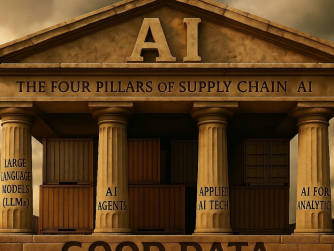
One way to make sense of where AI is headed is to view it through four interconnected pillars that are increasingly shaping how organizations deploy intelligence at scale.
**Large language models** allow systems to interpret and generate human language, reducing friction in communication and documentation. **Analytics platforms** help organizations understand patterns, forecast risk and make more informed decisions. **Physical AI**—often referred to as applied AI in operational environments—connects digital systems to the real world through computer vision, sensors and OCR, providing visibility into what is actually happening on the ground.
AI agents sit at the center of these pillars. They are the connective tissue that turns understanding into execution. Agents use language models to reason, Applied AI to interpret real‑world conditions, analytics to anticipate what may happen next, and then act within defined workflows to keep operations moving. In practice, this is the difference between insight and outcome.
## Data as the Foundational Layer
None of these pillars function without a foundation that often receives less attention: data.
Data is not simply an input into AI systems. It is the connective layer that allows agents to operate reliably across organizations, vendors and operational environments. AI agents do not replace people; they replace brittle, manual data handoffs that slow operations and introduce error.
Without clean, contextual and timely data:
– Agents cannot determine when or how to act.
– Applied AI cannot accurately reflect physical reality.
– Analytics remain backward‑looking.
– Language models generate confident but unreliable outputs.
As organizations move from experimentation toward production AI, data quality shifts from a technical concern to a strategic one.
## From Experimentation to Execution
This transition is no longer theoretical. According to DigitalOcean’s Currents research (February 2026), organizations are increasingly prioritizing AI applications and agents that run real workflows over isolated model experimentation. A majority of respondents now see long‑term value in agents rather than model training alone, and more than half report measurable productivity gains from using AI agents in practice.
The market is moving past the question of whether AI works. The more relevant question now is whether AI can operate reliably, at scale, inside real systems with real constraints.
## A Grounded View of Where We Are
Despite the momentum, it is important to be clear‑eyed about the limitations. Today’s AI agents are not omniscient. They hallucinate. They require guardrails. They perform best in narrowly defined roles with human oversight. This is not the future imagined in science fiction—and that is a good thing.
The internet followed a similar path. Early versions were unreliable, fragmented and difficult to use. Over time, standards emerged, infrastructure improved and connectivity became assumed. AI agents are following the same arc, quietly evolving from experimental tools into operational infrastructure.
## Why This Matters for the Supply Chain
Supply chain and intermodal operations are not constrained by lack of dashboards or reports. They are constrained by coordination, timing and execution across fragmented systems. Delays often occur not because information is unavailable but because no one—or nothing—is responsible for acting on it in time.
AI agents address this gap by operating between insight and action. They reduce dependency on manual coordination, lower cognitive load for teams and help organizations respond to issues before they cascade.
## Polling as Governance, Not Theater
This is also why operator input matters. AI should not be designed or deployed in a vacuum. Live polling and real‑time feedback are not engagement tactics; they are governance mechanisms. They surface where assumptions break down, where automation creates friction and where human judgment must remain central.
This February 2026, the Intermodal Association of North America will continue the **Four Pillars of AI** webinar series with a dedicated focus on AI agents. These sessions incorporate live audience polling to capture practitioner perspectives and pressure‑test ideas in real time. That input is directly informing a best‑practices white paper on how to responsibly and effectively leverage AI in the supply chain.
Volume 1 of that white paper is planned for release in Q2 2026, with a focus on establishing practical foundations before the industry standardizes around the wrong patterns.
## From Question to Infrastructure
When my nephew asked whether The Matrix was real, he wasn’t really asking about a movie. He was asking how to make sense of a world where technology advances faster than our intuition can keep up.
When I was in college, high‑speed internet felt impossible… today, it is invisible.
AI agents are on the same path: not flashy or cinematic, just quietly becoming infrastructure. And when that happens, we will stop asking whether they are real at all.


Latest posts by Chris Machut (see all)
- AI Is an Amplifier, Not a Shrink Ray - July 14, 2026
- From Buzz to Blueprint: Two Years on the Road with the Four Pillars of AI - June 17, 2026
- The First AI Shift Has Already Happened - May 12, 2026